Justice Snapshot Sri Lanka 2025
JUSTICE SNAPSHOT SRI LANKA 2025

THE JUSTICE SNAPSHOT
The Justice Snapshot Sri Lanka is a rapid assessment of the justice system as it operated across the island in the year ending 31 December 2024.
The assessment was commissioned at the request of Government by the Support to Justice Sector Project (JURE), funded by the European Union, in partnership with the Ministry of Justice, and implemented by UNDP and UNICEF Sri Lanka, to provide an evidence base to inform policy and budgetary allocation, as well as to strengthen institutional capacity to capture justice system data.
This is a collaborative product of government, the JURE Project, justice institutions and individual justice actors/practitioners.
A process to improve data collection and inform policy making, providing an agreed set of data all can plan around
This Justice Snapshot is intended as the start of a process that sees government and justice institutions investing more in their own data. The data belongs to the government and institutions concerned.
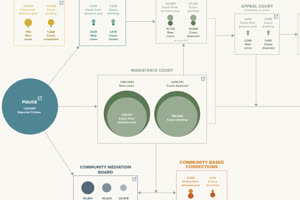
The Situational Overview provides the context in which statutory justice services function. It shows the flow of cases entering the system and how they are processed by the system. It also shows the governance mechanisms in place nationally, as well as the budgetary allocations available to the institutions within the justice system.
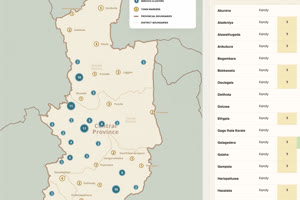
Justice Services shows the resources (material and human) and infrastructure with which justice service providers work.
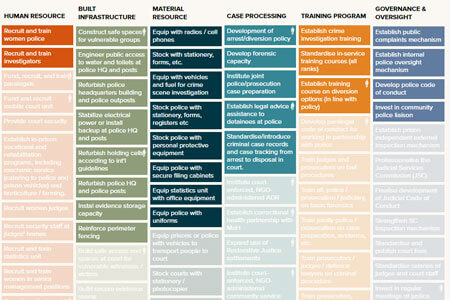
The Action Matrix sets out a number of Justice Investment Options indicated by the data and institutional Annual Performance Reports to fill the gaps in justice services and resolve system blockages indicated by the data collected.
The Roadmap advances an activity plan over five years (2026-2030) drawn from the Action Matrix and aligned with government policy documents and the Sustainable Development Goals (SDGs).
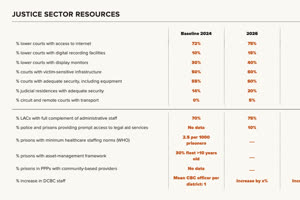
After Acknowledgements and Methodology, Baseline Data contains all the supplementary data collected and cleaned. The data contained in any visualisation can be cross-checked here. The Library is a repository of all documentation relevant to the justice sector, including the laws.
A working tool rather than stand-alone report
The Justice Snapshot should be used as a tool to follow a particular line of enquiry, rather than as a report to read through section by section.
Navigating tip 1: Click, click, click
Start with a question and then follow the line of questioning; or pick a strand and see where it leads. Click on the Data Note icon at the top of each page to check the source of the data visualised.
Navigating tip 2: Filter the Investment Options
The Action Matrix and the Justice Investment Options provide many options. To filter them, click on > Built Infrastructure and filter by > Court.
You may also view these options from the point of view of the most marginalised and vulnerable groups by adding > Human Rights.
Navigating tip 3: Data do not / will not always add up
The data are provided in good faith; there will be errors and these errors are identified or indicated where they are apparent. This exercise marks the beginning of a process to improve data collection locally which will inform policy making nationally.